
If your home runs on a private well, the pump is the part you never think about until the water stops. It is also the part that decides how steady your pressure is, how well your system handles an Anchorage winter, and how much you will pay to keep it running over the next decade or more.
Most residential wells use one of two pump types: a submersible pump or a jet pump. Here is the short answer. Submersible well pumps are the standard choice for most wells deeper than about 25 feet, and they have clear advantages in cold climates. Jet pumps still make sense for shallow wells and some existing setups. The details of your well, your pump house, and your household decide which one fits.
This guide walks through how each pump works, where each one performs best, and what to weigh before you replace or install a pump on your property.
How Each Type of Well Pump Works
The two pumps move water in opposite ways, and nearly every difference between them comes from that.
Submersible well pumps
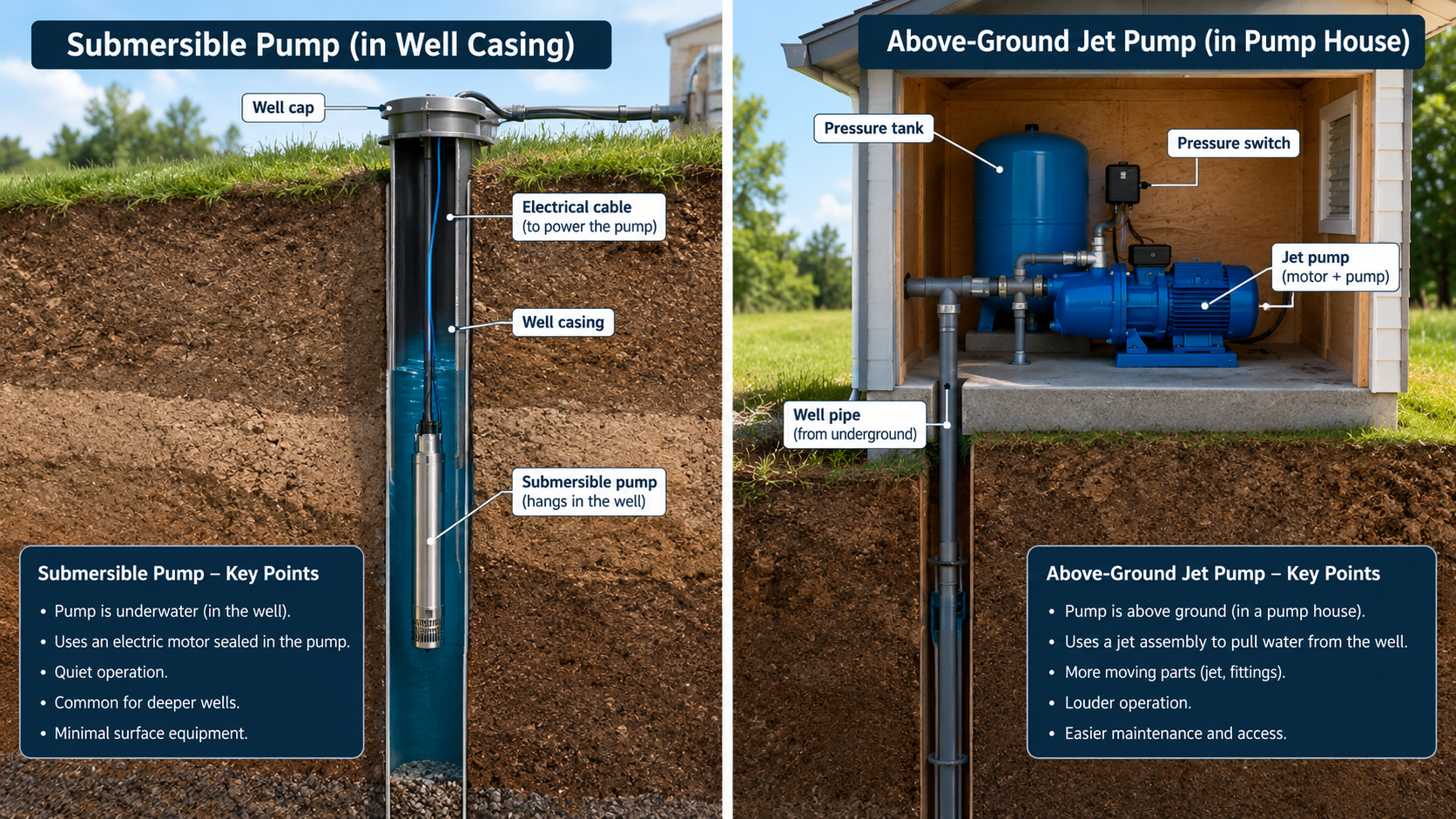
A submersible pump sits inside the well, below the water level. The pump and its sealed motor are a single long, narrow unit that hangs on a drop pipe. Because it sits underwater, it pushes water up and out of the well toward your home instead of pulling it.
Pushing is more efficient than pulling. The motor is also cooled by the water around it, which is part of why submersible pumps handle long run times well. Water travels up the pipe to a pressure tank in your home, where it is stored and delivered at a steady pressure.
Jet well pumps
A jet pump sits above ground, usually in a basement, utility room, or pump house. It pulls water up from the well using suction and an ejector that uses moving water to create a vacuum. There are two main versions.
A shallow well jet pump uses a single pipe and relies on suction alone. Suction has a physical limit, and in practice a shallow well jet pump works for wells with the water roughly 25 feet or less below the pump.
A deep well jet pump places the ejector down in the well and uses two pipes, one that sends water down to the ejector and one that returns water up. This extends the working depth, generally to around 100 feet, sometimes a little more with the right setup. It is also less efficient, because part of the water the pump moves is recirculated through the ejector.
Well Depth Often Makes the Decision for You
Before comparing features, check your well depth and your static water level, which is how far down the water sits when the pump is off.
If your water level is deeper than roughly 25 feet, a shallow well jet pump is ruled out. Suction cannot lift water that far reliably. That leaves a deep well jet pump or a submersible pump.
Between those two, depth keeps pushing the answer toward submersible. Submersible pumps are built for wells that run to hundreds of feet, and their performance does not fall off the way jet pump performance does as the water gets deeper. If your well is deep, or if you are drilling a new well, a submersible pump is usually the practical choice.
If your well is shallow and you already have a working jet pump, replacing it with a similar jet pump can be perfectly reasonable. It depends on the condition of the rest of your system and what you want from it.
Cold Weather and Freeze Protection in Alaska
This is where Alaska changes the conversation. A pump choice that works in a mild climate can become a recurring winter problem here.
A submersible pump sits down in the well, well below the frost line. The water around it stays above freezing, and the pump itself is not exposed to winter air. The line that carries water from the well to your home runs through a pitless adapter and buried piping, which keeps the connection below the depth where frost reaches.
A jet pump lives above ground, so it depends on the space around it. In a heated basement or a properly heated and insulated pump house, it works fine. If that space loses heat during a deep cold snap, a power outage, or a heater failure, the pump, its fittings, and the lines to it can freeze and crack. The pressure tank and piping in that space face the same risk.
None of this disqualifies jet pumps in Alaska. It means the pump house or utility space needs to be reliably heated, and you need to be honest about how reliable it really is during the coldest weeks of the year.
Efficiency and Operating Cost
A well pump runs often, so small differences in efficiency add up on your power bill over the years.
Submersible pumps are generally more efficient because they push water from below. Their motors are sized to the job and they do not waste energy overcoming suction. Deep well jet pumps are the least efficient of the three types because of the recirculating ejector. Shallow well jet pumps sit in between, and they perform well within their depth range.
Efficiency also depends on getting the pump sized correctly. A pump that is too large cycles on and off too quickly and wears out early. A pump that is too small struggles to keep up when several fixtures run at once. Matching the pump to your well’s yield, your depth, and your household’s water demand matters more than the pump type alone.
Noise and Where the Pump Lives
Because a jet pump sits inside or next to your home, you hear it. The hum is easy to ignore in a detached pump house, but in a utility room next to a bedroom or living area it can be noticeable, especially when it starts up.
A submersible pump is down in the well, so you will not hear it at all. Many homeowners do not realize how loud their old jet pump was until it is replaced with a submersible and the house gets quieter.
If you value a quiet home, or you are building a new house and want the mechanical room to stay clean and simple, that is a real point in favor of a submersible pump.
Maintenance and Repair Access
Here the tradeoff reverses, and it is worth being clear about.
A jet pump is easy to reach. If something goes wrong, a technician can inspect the pump, the pressure switch, the tank, and the fittings without pulling anything out of the ground. Jet pumps can also lose their prime, which means they lose the water they need to create suction. When that happens, the pump runs but delivers little or nothing until it is primed again.
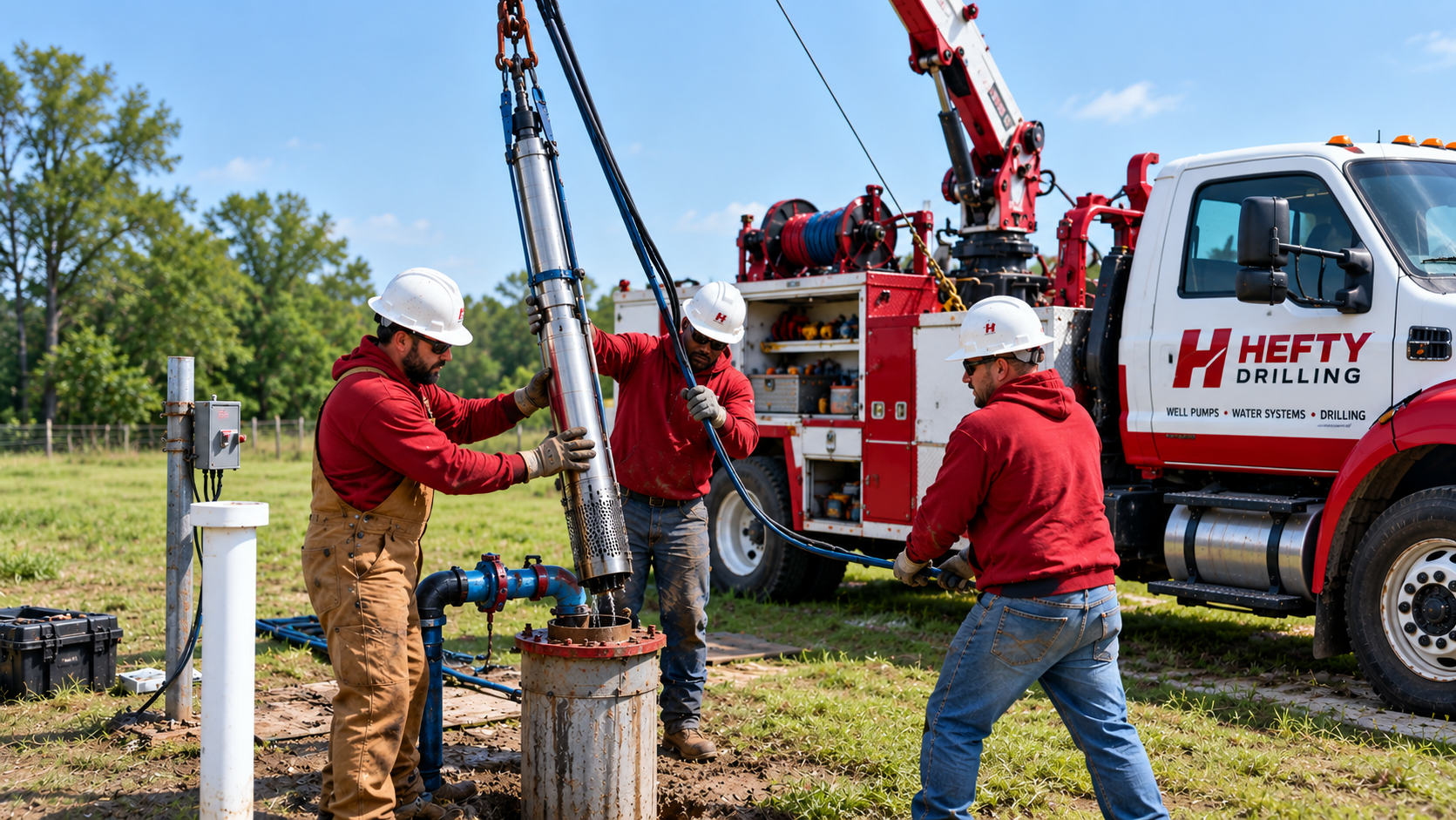
A submersible pump is out of sight and out of mind, which is both its strength and its drawback. It rarely needs attention, but when it does fail, the pump has to be pulled out of the well on its drop pipe. That is heavy work that calls for the right equipment and experience, and it is not a good do-it-yourself project. The pump cable, the drop pipe, and the wellhead connection all have to come out and go back in without damage.
For this reason, a well inspection before replacement is worthwhile. A video inspection of the casing can show cracks, corrosion, or obstructions, so you know whether the problem is the pump or the well itself before you spend money on a new one. Hefty Drilling offers well inspections for exactly that purpose, including component inspections for homes being bought or sold.
How Long Each Type Lasts
Lifespan depends on water quality, how often the pump cycles, how well it was sized, and how it was installed. As a general expectation, both pump types commonly last in the range of 10 to 15 years, and some run longer under good conditions.
Several things shorten that. Sand and sediment in the water wear down impellers in either pump type. Iron bacteria and mineral scale can reduce flow and strain the motor. A pump that short cycles because of a failing pressure tank or switch will wear out sooner than one that runs in steady, longer cycles. If your well has recurring sediment or iron problems, well cleaning to remove rust scale, iron bacteria, and sediment can protect the pump you install next. Hefty Drilling offers well cleaning as part of its service lineup.
Do Not Overlook the Pressure System
The pump is only one part of the system that delivers water to your faucets. The pressure tank, pressure switch, and controls decide how smoothly that water arrives.
If your water pressure rises and falls, or your pump seems to switch on and off constantly, the problem is sometimes the pressure tank and not the pump. Replacing a pump without checking the tank can leave you with the same symptoms and a new pump that wears out early.
Hefty Drilling also offers pressure system upgrades using the Grundfos SmartFlo system, which is designed to keep water pressure constant. If you are already replacing a pump, that is a good time to ask whether upgrading the pressure system makes sense for your home.
Signs Your Current Pump May Need Replacing
Not every pump problem means a new pump, but these symptoms are worth taking seriously:
- Water pressure that is weaker than it used to be
- Sputtering faucets or air in the lines
- A pump that runs constantly or cycles on and off rapidly
- A sudden jump in your electric bill
- Cloudy, sandy, or discolored water
- Strange noises from the pump or pressure tank
- No water at all
If your water has stopped completely, start with the basics in our guide on what to check when a well pump stops working before you call anyone. If those checks do not solve it, or if the pump is old, a professional diagnosis will save you from guessing.
Questions to Ask Before You Choose
Run through these before you commit to either pump type.
- How deep is the water in your well? Water deeper than roughly 25 feet rules out a shallow well jet pump.
- Where will the pump live, and will it stay heated? A jet pump in an unreliable pump house is a freeze risk.
- How much water does your household use? The pump has to match your demand and your well’s yield.
- How old is the rest of your system? An aging tank, switch, or piping can undermine a new pump.
- What condition is the well itself in? A damaged casing or heavy sediment can ruin any pump.
- Who will service it? Make sure the contractor you choose can handle pump removal and installation in cold-weather conditions.
Frequently Asked Questions
Are submersible well pumps better than jet pumps?
For most wells deeper than about 25 feet, yes. They are more efficient, quieter, and better protected from freezing. Jet pumps remain a reasonable choice for shallow wells where the pump is in a reliably heated space.
Can I switch from a jet pump to a submersible pump?
Often, yes, but it depends on your well’s diameter, depth, and the condition of the casing and piping. The pressure tank and electrical setup may also need changes. A professional inspection will tell you what the swap involves.
How do I know if my well needs a submersible pump?
Check your well depth and water level. If the water sits deeper than roughly 25 feet, a submersible pump is usually the more practical option, since a shallow well jet pump cannot lift water that far.
Is a submersible pump safe to leave in the well during winter?
Yes. Because the pump sits below the frost line and under water, it is protected from the freezing air that threatens above-ground equipment. That is one reason submersible pumps are common in cold climates.
Get the Right Pump for Your Alaska Well
The best pump for your home is the one that matches your well depth, your water demand, and your winter conditions, and a quick look at your system is usually enough to tell which that is. Hefty Drilling has been installing well pumps in Anchorage since 1978, and our well pump installation team can inspect your well, explain your options, and install a pump that is built for Alaska. Call us at (907) 830-9985 for a free estimate.
